

A Program with Education for Student Visa is essentially a formal education program that is combined with the eligibility criteria which are supportive of the Wospac international study plan. For a very large number of students, choosing the right program is not only a matter of academic interest, but it is also a condition that they have to meet their visa requirements in a simple and well-organized way. Educational programs related to student visas are designed to offer an environment that is consistent with both the learning outcomes and the legal study permissions.

Students who wish to study abroad usually pick a program that provides them with academic value and institutional support, and at the same time, the program complies with visa regulations. A Program with Education for Student Visa plays a pivotal role in fulfilling these requirements as it offers recognized educational pathways along with the necessary supporting documentation and enrollment standards.
Understanding a Program with Education for Student Visa
A Program with Education for Student Visa is normally an academic or a training route that fulfills the primary requirements of a student visa. These programs are arranged around the accredited institutions of learning and the defined periods of study. The educational aspect is the main one as visas are generally granted on the account of enrollment in the authorized programs.
Such programs may include university-level courses, career development, or educational levels that are formalized. The main thing is the compliance of the program’s educational objectives with the visa rules. The institutions that offer such programs generally follow standard academic calendars and have the same reporting structures.
Core Elements of an Educational Program
| Core Element | Description |
| Educational structure | Organized courses or training |
| Enrollment basis | Recognized academic institution |
| Duration | Defined study period |
| Compliance focus | Alignment with visa requirements |
| Student role | Active participation in education |
Why Education-Based Visa Programs Matter
Education-based visa programs constitute the main instruments of international mobility. They set a legal and academic framework under which students can access educational opportunities abroad. In the absence of such programs, it would be a real maze to deal with the different visa systems.
First of all, visa programs based on education are very transparent. Students understand that the main condition for them to be granted a visa is their participation in the educational process. This lessens the students’ uncertainty and makes them more willing to keep up their studies.
Key Components of Education Programs for Student Visas
Education programs that are designed for student visas normally have a few shared components. These components are meant to preserve both the integrity of the academics and the clarity of the administration.
Academic Framework
The academic framework specifies the content of the students’ study as well as the way their progress is measured. It may include requirements for coursework, assessments, and even attendance.
Institutional Support
Institutions that provide such programs are usually ready to offer administrative support to the students. This may involve the provision of enrollment confirmation, academic records, and structured schedules.
Comparison With Other Study Pathways
Different study options for international students are not necessarily structured in the same way. Comparing a Program with Education for Student Visa with other pathways helps to understand better the role of the former.
For instance, short-term courses may not be eligible for student visas. Informal training programs may not have the recognition of institutions. On the other hand, education-based visa programs are developed precisely to coordinate learning with visa frameworks.
Program Format Comparison
The following graph provides a conceptual comparison of common study formats based on structure and visa alignment.
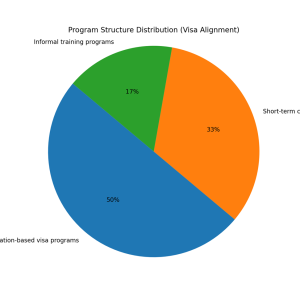
- Education-based visa programs show the highest level of structure and compliance.
- Short-term certified courses offer a moderate structure with limited visa alignment.
- Informal training programs rank lowest in overall structure.
- Higher program structure generally indicates better alignment with visa requirements.
Practical Factors When Choosing a Program
While assessing a Program through Education for Student Visa, students often weigh several practical factors. These considerations mainly emphasize the suitability of the program rather than the results of the program.
- Program duration and academic calendar
- Institutional recognition and structure
- Level of academic support provided
- Compatibility with personal study goals
These are the aspects that students use to filter their choices without making the decision process too complex.
Documentation and Academic Records
Documentation constitutes the main component of education-based visa programs. These are records of enrollment, academic transcripts, and attendance reports that are usually kept by institutions. Such records are the proof of participation in education.
For the student, proper documentation is the source of clarity. It serves as a means to track academic progress and gives formal evidence of the study. Schools are generally in charge of these records as part of normal academic administration.
Comparing Structured Education and Flexible Learning
Some students might find flexible learning choices attractive; however, such options are frequently devoid of the formal structure necessary for student visas. A program with education for a student visa keeps consistency and control as its main priorities.
Structured education provides regular schedules and clearly defined results. Flexible learning gives freedom to the learner but it may not be compatible with visa frameworks.
Long-Term Academic Planning
Just as a first advantage, education-based visa programs open the door to long-term planning. A structured curriculum gives students the opportunity to plan their academic voyage over time. This is in line with continuity and progression in one educational framework.
Students who are planning for a long period of study are usually the ones choosing programs with clear academic stages. These stages facilitate setting goals and assessing progress.
Common Reasons Students Choose Education-Based Visa Programs
Students regularly refer to the same reasons when explaining their choice of these programs:
Clear alignment with student visa requirements
- Recognized academic structure
- Predictable study schedules
- Institutional administrative support
These reasons emphasize the practical side that appeals to students from well-structured education programs.
Summarizing the Program with Education for Student Visa
An Wospac Education Program for a Student Visa is a well-organized international study plan. It clearly and logically links academic participation with the eligibility for a visa. We discussed the organization of such programs and their importance throughout this article.
By putting the focus on recognized institutions, set curricula, and verified participation, these programs become a safe option for a great number of students. Instead of concentrating on results, they put emphasis on structure and compliance.
Students who are going to study abroad would be wise to familiarize themselves with the framework of an Education Program with a Student Visa as their first step. With clear requirements and well-organized learning routes, these programs serve as a solid base for academic ventures abroad.
Keep exploring Program with Education for Student Visa: A Complete Guide for Students with these next reads
Questions that often follow Program with Education for Student Visa: A Complete Guide for Students
Why can Program with Education for Student Visa: A Complete Guide for Students matter more than it first appears when the right format is not clear yet?
Because Program with Education for Student Visa: A Complete Guide for Students rarely points to only one moment or one result. It usually says something about daily structure, level of support, timing or training fit, and those details often shape whether a player can keep improving in a meaningful way.
What usually matters more than the headline when people compare Program with Education for Student Visa: A Complete Guide for Students when the right format is not clear yet?
They usually get more value when they judge the full week behind Program with Education for Student Visa: A Complete Guide for Students: football load, study balance, living format, travel, recovery and emotional readiness. Looking at the whole routine often makes the next decision far clearer.
How can families use Program with Education for Student Visa: A Complete Guide for Students when they are still comparing options when the right format is not clear yet?
Program with Education for Student Visa: A Complete Guide for Students can be useful as one piece of evidence, especially when it is compared with Football Summer Camp Barcelona and other realistic options. The strongest decisions usually come from weighing fit, timing and support together rather than reacting to one detail on its own.
What often makes the next decision clearer after Program with Education for Student Visa: A Complete Guide for Students when the right format is not clear yet?
A direct comparison with Football Summer Camp Barcelona or another closely matched route usually helps. Once the player’s current level, weekly rhythm and long-term aim are judged together, the next move tends to feel much less confusing.


