A planned year away from usual commitments can give a young athlete time to focus on football and consider their next decision. A Gap Year Football Program in Spain should be examined through the activities actually offered, rather than a promise of accelerated development. Begin with the player’s current level, proposed dates and educational responsibilities. These details help turn an attractive idea into a programme that can be assessed.
For a WOSPAC enquiry, establish which football, accommodation and study arrangements are available for those circumstances. A longer stay creates different practical questions from a short camp, but duration alone does not establish quality, inclusion or career prospects.
A football-focused year can give training a central place in the week. That does not make it an all-inclusive package or make other ways of spending a year less serious. Ask how coaching is organised and whether any confirmed matches involve different teams. Clarify the age group, competition format and conditions for participation rather than assuming a particular fixture or scouting event.
Language learning and cultural activities can be considered alongside football. Check whether they are organised parts of the offer, optional additions or activities the player would arrange independently. Knowing who provides each activity helps identify both costs and responsibilities before travel.
What a football-focused year can involve
The intended balance is individual. One player may want sustained technical practice, while another is deciding whether a different training environment suits them. Discuss these aims without treating a gap year as a necessary step for every ambitious footballer.
- Coaching: Confirm the assigned staff, relevant qualifications and session frequency for the actual group.
- Education: Identify any language course or formal study provider and check admission and timetable requirements.
- Residential arrangements: Establish the address, included services and the supervision appropriate to the player.
- Competition: Ask which match activities are confirmed and how selection or participation is decided.
| Feature | Gap Year Football Program in Spain | Traditional Gap Year |
| Focus on Football | Intensive training, professional coaching | The amount of football depends on the activities chosen. |
| Academic Opportunities | Confirm whether language teaching or coursework is available and who provides it. | Depends on program |
| Local life and language | High (living in Spain, exposure to local culture) | The setting and opportunities depend on the chosen placement or course. |
| Career Exposure | Confirm matches separately; any outside assessment needs its own arrangement. | Professional or academic opportunities depend on the purpose and selection conditions. |
These differences help compare purposes rather than rank every year abroad. A football programme puts sporting activity at the centre, whereas an academic or volunteer placement may prioritise another commitment. Each still needs clear terms, a realistic workload and suitable support.
Understanding the proposed weekly programme
Ask for a representative week that identifies organised sessions, travel and time outside training. It should be clear which activities are scheduled and which depend on availability or individual selection. The player also needs time for any agreed study and ordinary responsibilities.
Football practice and review
Technical practice can explore receiving, passing and control, while game activities create decisions about space and movement. Physical preparation should be discussed in relation to the player’s age, experience and other commitments. More sessions do not automatically mean a better experience.
Feedback gives practice a subject to revisit. Ask whether the advertised format includes individual discussion, group review or video analysis. A specific example, such as when to support a teammate after a pass, is easier to evaluate than a general claim that the player is becoming professional.
Matches are a separate part of the enquiry. Find out which are confirmed, what the relevant level is and whether every participant can play. A proposed tournament or an opponent’s reputation cannot establish an entitlement to a trial or a contract.
Study and everyday experience
A year abroad can include language practice through daily interactions, but a formal course requires a named provider and its own terms. If the player intends to continue existing studies, check attendance, assessment and recognition with the relevant institution before relying on flexibility.
Compare study and training times with meals, travel and rest. Discuss who handles a timetable conflict and whether support is available for the language used in lessons. The combination of sports and studies needs practical coordination. It does not guarantee success in either activity. Keep educational decisions connected to the player’s longer-term plans, including the requirements of any institution they hope to attend next.
Comparing football with academic and volunteer options
When comparing ways to spend a year, start with the main objective and the commitment required. A sporting focus, a course and a volunteer placement can each serve a different purpose. Their value depends on the actual organisation and the participant’s needs.
- Football-focused year: Compare the group, coaching, match activities and practical arrangements.
- Volunteer placement: Examine the work, responsibilities, support and purpose of the placement.
- Academic year: Review the course, recognition, workload and any separately arranged sporting activity.
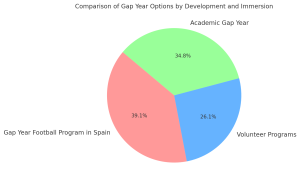
The 39.1%, 26.1% and 34.8% slices form an illustrative comparison without a stated metric, dataset or common denominator. They are not measured development rates, success probabilities or evidence that one kind of gap year is better than another.
Use the actual terms to decide whether Spain’s football activities match the player’s priorities. The comparison should remain qualitative when no common measurement or dataset is available.
Questions before choosing a football gap year
Parents and players can make the discussion more useful by agreeing what the year is intended to achieve. Consider the player’s willingness to live away from home and the amount of support needed. A suitable choice depends on these circumstances, not on a promise that one model fits everyone.
- Coaching staff: Ask who works with the group and check the specific qualifications or experience claimed.
- Academic arrangements: Confirm any course provider, admission conditions and compatibility with training.
- Facilities and welfare: Check actual access, supervision and how qualified healthcare is obtained when needed.
- Activities outside football: Identify what is organised, optional or independently arranged, including costs and responsibilities.
Keep a record of the answers and compare them with the booking terms. If a service remains unclear, resolve that point before treating it as an inclusion. Review accommodation, meals and travel alongside training so that the ordinary week is manageable.
Set a realistic point for reviewing the experience. The player might discuss what they have practised, what feedback they understand and whether the programme still suits their aims. Development can vary; a review should allow questions and revised objectives rather than demand a predetermined result.
Making a decision about WOSPAC
For a player considering a football-focused year in Spain, Wospac can explain the current offer relevant to the enquiry. Provide the intended dates, current playing experience and study commitments, then request a clear account of the proposed group and practical arrangements.
The decision should rest on what the player is joining and what support is agreed. A training stay can provide activities and feedback, while schools, competition organisers and clubs retain their own requirements and selection decisions. No programme should be understood as ensuring faster progress, a scholarship or professional recruitment.
A useful year has a purpose that can be discussed and revisited. It should leave the athlete better informed about the experience and their choices, without making a future career the condition for judging every session worthwhile.
Keep exploring Gap Year Football Program in Spain Wospac: Unlocking Opportunities for Young Players with these next reads
Questions about choosing a football gap year in Spain
What is the purpose of a football-focused gap year?
It gives football a central place in a planned period away from usual commitments. The player should define realistic aims and examine the actual training and practical offer; the format does not ensure faster development.
Which training and study arrangements should be confirmed together?
Check the group, staff, session schedule and review format, alongside any course provider, admission and timetable. Include travel, meals and rest when assessing whether the proposed week is workable.
How can football, academic and volunteer gap years be compared fairly?
Compare their purposes, responsibilities, organised activities, costs and support. Without a defined shared measure, an illustrative percentage chart cannot rank their outcomes or determine which suits a particular participant.
What evidence should be requested for matches and player review?
Ask for confirmed match arrangements, level and participation conditions, plus the format and frequency of feedback. Any external scouting or trial requires separate confirmation and does not follow automatically from enrollment.